To prepare your dog for boarding, start about four weeks out and cover four things: vaccines, a practice visit, packing, and a calm drop-off. Most first-timer problems (an expired shot, a surprise bedding rule, a dog who has never seen the building) are easy to fix with that much lead time.
Here's our opinion, and we'll stand behind it: book a daycare trial day before any first overnight stay, wherever you board.
How far in advance should you start preparing your dog for boarding?
About four weeks. That window covers vaccine lead times, a vet visit if one is due, and a trial day without rushing. If your dog still needs the canine flu series, start earlier.
Here's the checklist at a glance:
| When | What to do | Why it matters |
|---|---|---|
| 4 weeks out | Check vaccine records, book a vet visit if needed, and ask for the facility's vaccine windows | Boosters take time to count, and vet calendars fill up |
| 3 weeks out | Book the meet and greet and a daycare day | Familiarity beats every other prep step |
| 2 weeks out | Practice short departures and confirm flea and tick prevention | Alone time stops being a surprise |
| 1 week out | Portion food, write medication notes, gather contacts | No packing scramble |
| Drop-off | Keep the goodbye short and calm | Dogs mirror your mood |
| After pickup | Plan a quiet evening and watch for coughing | Tired is normal, coughing is not |
Which vaccines does your dog need before boarding?
Most boarding facilities ask for rabies, distemper and parvo (DA2PPV), Bordetella, and canine influenza, but details vary. For example, VCA Coral Animal Hospital (opens in a new tab) asks for Bordetella within six months, while we accept 12 months. Call yours before you book a vet visit.
Here are our requirements for dogs 6 months and older:
- Rabies and DA2PPV: current, or given at least 14 days before arrival if expired.
- Bordetella: intranasal at least 7 days before arrival, oral or injectable at least 14 days before. Renew every 12 months.
- Canine influenza: two doses 2 to 3 weeks apart, then an annual booster.
- Flea and tick preventative: your dog needs to be on a regular one.
Bordetella is the vaccine aimed at kennel cough, formally called canine infectious respiratory disease complex (CIRDC). The intranasal form gives faster coverage, so we accept a shorter lead time for it.
One honest caveat: vaccines lower the risk, they don't erase it. Cornell's Riney Canine Health Center (opens in a new tab) says the kennel cough vaccine reduces how severe the illness gets rather than blocking infection, and that symptoms can appear 2 to 10 days after exposure.
If your dog has never had the flu vaccine, that two-dose series is the slowest item here. Ask your vet to start early, and ask the facility how long after the second dose your dog can arrive. Our full vaccination policy lists exact windows.
Why should you do a meet and greet and a daycare trial first?
Familiarity cuts down surprises. A dog who has already seen the building, met the staff, and played in the yard treats boarding night as a return visit.
Think of it like walking a kid through a new school the week before the first bell. By the real first morning, the hallway is no longer a mystery.
A meet and greet is a hands-on, slow introduction to other dogs, and it's how a facility sorts dogs into play groups. A daycare day is the easiest trial run, because your dog gets the full routine while you're still nearby.
One family told us their dog did daycare right after her meet and greet, then walked into her boarding stay without hesitating and went home relaxed.
No daycare option? AKC Reunite (opens in a new tab) (July 2023) suggests a one-night trial stay before busy travel seasons. Still choosing a facility? Our virtual tour shows the space first.
How do you handle separation anxiety before boarding?
Practice short, dull departures at home, then stretch them out. An Austin Animal Center behavior handout (opens in a new tab) suggests repeating your leaving cues (grabbing keys, putting on a coat) without leaving, then building up to absences under about ten minutes.
Keep goodbyes and homecomings low-key, and run a few rounds a day for two weeks.
If your dog panics even at short absences, talk to your vet or a trainer before you book a long stay. Boarding won't fix separation anxiety, and we'd rather tell you that now.
What should you pack to prepare your dog for boarding?
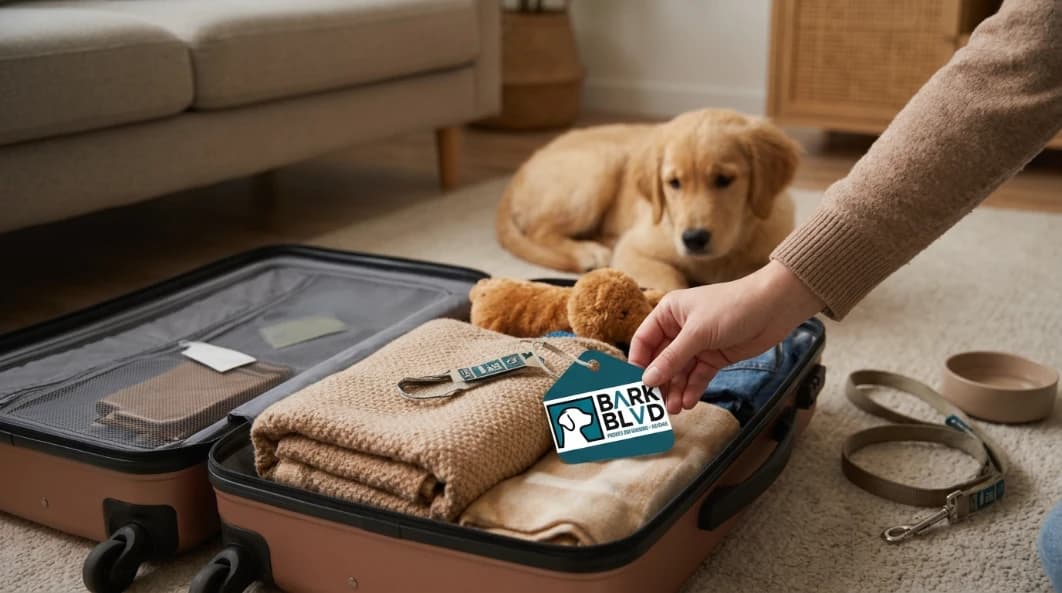
Here's what to pack for dog boarding: regular food, written medication instructions, and only the comfort items your facility allows.
- Regular food in meal-sized bags: label each bag. A sudden diet change can upset some dogs' stomachs, so most facilities, including ours, ask you to keep the diet the same.
- Medications with written instructions: dose, timing, and how your dog takes it.
- Comfort items, if allowed: we provide raised beds and freshly laundered blankets, so check with us before bringing personal bedding. Toys and treats are fine at your discretion.
- Contacts: your vet, plus a second person who can decide if staff can't reach you.
- A collar with current ID tags.
What one facility asks you to bring, another asks you to leave home. That's why we say call first.
What should you tell the boarding staff before drop-off?
Tell staff about anything that changed recently, because small details change how a dog is handled. Mention these at reservation or check-in:
- New diagnoses, recent surgeries, or new lumps
- Vomiting or loose stool
- Resource guarding, meaning possessive behavior around food or toys
- Increased fearfulness, or any scuffle with another dog
- Aggression toward dogs or people, including bite risk
Dogs with medical needs can often be accommodated, so call ahead.
How do you say goodbye at drop-off?
Keep it short, calm, and a little boring. The AKC's long-standing kennel advice (republished by ABC11 (opens in a new tab) in 2017) is to skip the apologies, because your dog picks up on your unease and starts worrying too.
The first time is usually harder on you than on your dog. Depending on the suite, you'll get report cards, photos, or video, and some boarding suites include an in-suite camera, so you aren't left guessing.
What should you expect after your dog's first boarding stay?
Expect a tired dog. AKC Reunite notes that kennel dogs often come home worn out because the environment is busy and stimulating.
Plan a quiet evening, fresh water, and normal meals. Want your dog to come home fresh? Ask about a bath before pickup, which one guest family did.
Call your vet about coughing, lingering low energy, or a dog who won't eat. Kennel cough symptoms can take up to ten days to appear, so keep watching for about that long.
What else do first-time boarders ask?
Can my dog board if they don't like other dogs?
Often, yes. At Bark Blvd, a dog who doesn't do well with other dogs can still board as long as they're 100% people-friendly, and they get one-on-one play with staff instead of group play. Ask any facility whether it offers solo play, and be honest about your dog's history.
Can an unneutered dog board?
It depends on age and the facility. At ours, dogs over 6 months need to be spayed or neutered for group play. Unaltered dogs from 6 months to 2 years can board through our Solo Play program, kept apart from other households' dogs. We don't accept unaltered dogs over 2 years.
What if my dog's vaccines are overdue?
Overdue shots usually mean rescheduling. At our facility, expired rabies and DA2PPV vaccines must be given at least 14 days before arrival, and Bordetella has its own 7 or 14 day window. Book a vet visit as soon as you notice, then send proof so your reservation isn't at risk.
Will my dog be stressed while I'm away?
Some dogs need time to settle in, which is normal. Staff watch eating, bathroom habits, and behavior, and we contact owners right away if something urgent comes up. Depending on your suite, a report card or photos show how the stay is going.
Ready to book your dog's first stay?
If you're in southeast Iowa, see dog boarding in Mount Pleasant and pick the suite that fits your dog. Questions before your first stay? Contact our team and we'll walk you through it.
This guide is general information, not veterinary advice. Your vet knows your dog's history best. Bark Blvd, 905 E. Ash Street, Mount Pleasant, IA 52641. 319-710-6500.