
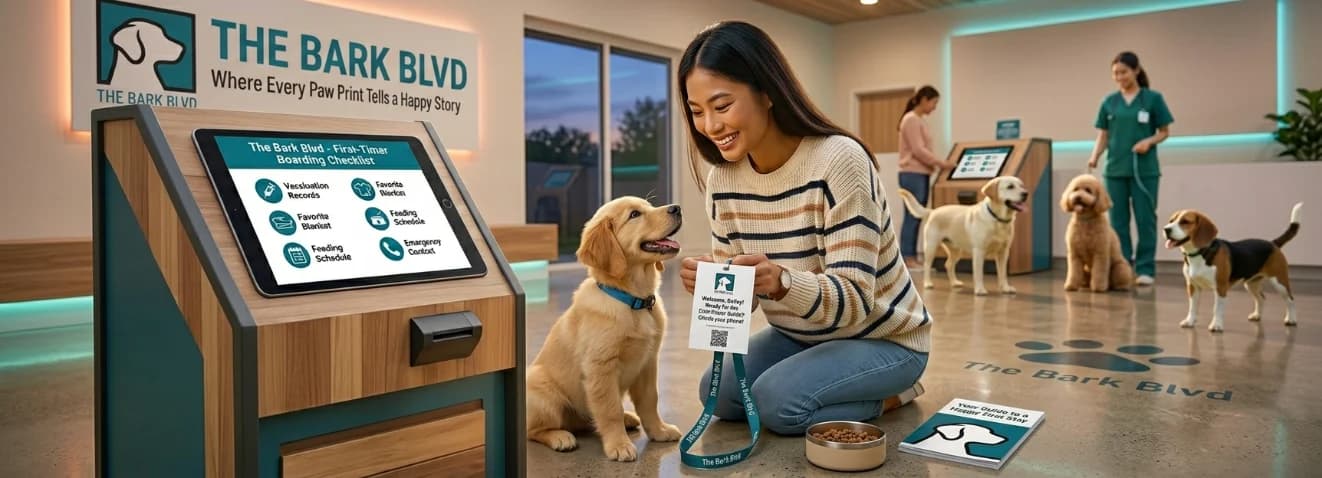
Cage-free dog boarding is usually the better fit for friendly, social dogs, but it isn't better for every dog. The right pick depends on your dog's temperament and on how well the facility runs its setup.
We run a cage-free facility, so weigh our view accordingly. We'd choose cage-free for most social dogs, after a meet and greet.
What is cage-free dog boarding, and how does it differ from a kennel?
Cage-free dog boarding means dogs spend the day in supervised play areas and sleep in private suites instead of locked cages. A traditional kennel houses each dog in its own run or enclosure, with play and exercise on a schedule.
Picture a hotel with a shared lounge. You get a private room to retreat to and a common space to mingle in.
The label has no single definition, so ask what it means at each place. At ours, dogs sleep in private suites with orthopedic bedding, then join supervised group play or get one-on-one play with staff, as of October 27, 2026.
Even cage-free isn't a free-for-all. Iowa's dog day care rule (opens in a new tab) (amended July 21, 2021) requires an enclosure for any dog not under direct supervision, plus two hours of daily rest.
| What to compare | Cage-free | Traditional kennel |
|---|---|---|
| Dog contact | Supervised group play | Often individual, plus scheduled outings |
| Rest | Private suite | Individual run |
| Injury risk | Higher, from group play | Lower |
| Illness exposure | Shared air and play areas | Shared air, fewer contacts |
| Best for | Friendly, adaptable dogs | Dogs who prefer solitude |
Is cage-free dog boarding easier on a dog's stress?
Often, for social dogs, but the research is more mixed than most marketing admits.
A 2007 review in Animal Welfare by Taylor and Mills (opens in a new tab) linked restrictive environments to poor welfare and called the evidence for group housing's benefits "strong." It also found considerable evidence for positive human contact, though study design limits some conclusions.
A 2014 study (opens in a new tab) in Physiology & Behavior followed 29 pet dogs and found higher cortisol (a stress hormone) ratios in the kennel than at home. The authors found no definitive evidence the dogs were negatively stressed.
Think of cortisol like a raised heart rate: it says something changed, not whether the dog felt fear or excitement.
When does a traditional kennel make more sense?
A kennel makes more sense for a dog who does better alone. Three cases come up most:
- Dogs who dislike other dogs: group play isn't fair to them. Many facilities, ours included, offer solo play instead.
- Dogs with complex medical needs: ask your vet whether a clinic's boarding unit fits better.
- Dogs with a history of aggression: Iowa's rule bars dogs known to be aggressive toward other dogs or people, so disclose past scuffles, guarding, or bite risk.

Does cage-free dog boarding raise the risk of injury or illness?
Yes, somewhat, because dogs share space and air. Iowa's rule has owners sign an acknowledgment of injury and disease risk when dogs from different owners mix. It also requires a temperament screening, direct visual supervision at all times, and one person per playgroup of 15 or fewer dogs.
Kennels carry illness risk too. Cornell's Riney Canine Health Center (opens in a new tab) says kennel cough spreads through droplets, contact, and shared objects, and appears 2 to 10 days after exposure. The vaccine reduces symptom severity but doesn't prevent infection.
Here's how we handle it. Our vaccination policy requires Bordetella, the vaccine aimed at kennel cough, and sick dogs stay home until they're symptom-free for 14 days and off medication.
New dogs get a hands-on meet and greet, and play groups form by size, temperament, and energy level. Our staff are first aid and CPR certified, and Northeast Animal Hospital is less than a mile away.
What should you ask any dog boarding facility before you book?
Ask to see everything, then ask how the facility handles screening, staffing, health, and emergencies:
- Is every area open for a tour? The Alberta SPCA (opens in a new tab) calls restricted areas or limited visiting hours a red flag.
- How do you screen and group dogs? The SF SPCA (opens in a new tab) wants groups matched by age, size, and energy level.
- What is the staffing ratio? The Alberta SPCA suggests one staff member to 12 to 15 dogs at most, and the SF SPCA asks about round-the-clock monitoring.
- What happens in an emergency? Look for a plan and a nearby vet.
- Is there a solo play option? It matters if your dog is selective.
Once you've picked a place, our guide on how to prepare your dog for boarding covers the timeline, and the dog boarding checklist covers packing.
What else do owners ask about cage-free vs. kennel boarding?
Is cage-free boarding more expensive than a kennel?
Not necessarily. Price tracks the suite and extras more than the label. Every suite we offer includes group play, and the current nightly rates for each one are on our dog boarding page. Daycare members get a lower nightly rate, so see our daycare memberships for details.
Can an anxious dog board cage-free?
Sometimes. At Bark Blvd, a dog who doesn't do well with other dogs can still board with one-on-one play if they're 100% people-friendly. A dog with true separation panic should see a vet or trainer first, because no boarding style fixes it.
Does a meet and greet really matter?
Yes. It's a slow, hands-on introduction to other dogs, and it protects your dog, the other dogs, and the staff.
Ready to try cage-free dog boarding in Mount Pleasant?
If you're in southeast Iowa, start with a daycare day or a meet and greet, then pick a suite on our dog boarding page. Questions first? Contact our team.
This guide is general information, not veterinary advice. Your vet knows your dog's history best. Bark Blvd, 905 E. Ash Street, Mount Pleasant, IA 52641. 319-710-6500.